
Students from the University of Southampton took part in a global competition to create innovative solutions to tackle SDG 13 (Climate Action), writes Alice Brock, Project Officer at the university’s Sustainability & Resilience Institute (SRI).
The University of Southampton was selected as one of five global universities to take part in the UN Sustainable Development Solutions Network (SDSN) Universities x Goal 13 (Climate Action) competition, sponsored by Siemens Gamesa Renewable Energy. This annual competition provides student teams the opportunity to work with Siemens Gamesa mentors to develop innovative projects to tackle SDG 13: Climate Action. The winning team will receive $10,000 to develop their proposal further.
SRI led the University of Southampton’s entry to this competition, that I coordinated with Deputy Director of the Institute Professor Simon Kemp.
Each of the five participating universities had to select student teams which could compete against each other for a place in the global final. We selected Teams through an internal selection process: student groups had to prepare a proposal of their project and complete an SDG Impact Assessment to demonstrate the SDG impact of their proposal.
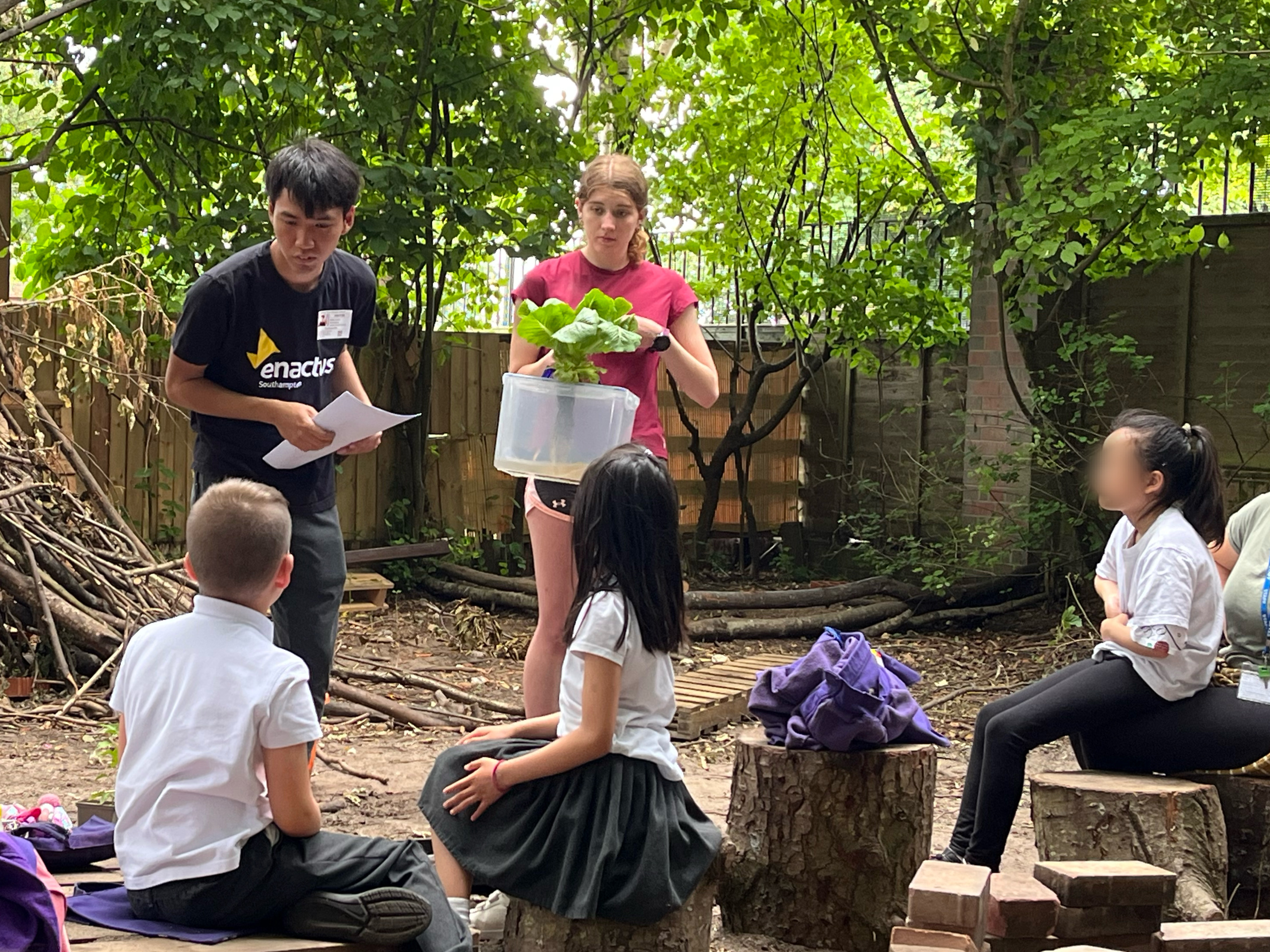
Our two selected teams were paired with Siemens Gamesa mentors to further develop their proposals. One of our teams, pictured above, proposed implementing of hydroponic systems in disadvantaged communities saving vital resources such as energy and water and reducing the overall carbon footprint of food production; the other team’s project was the development of a machine learning integrated platform to provide economically viable solar panel solutions to low- and middle-income countries, repurposing old solar panels for future use. Our teams then presented pitches to an external panel of experts, who chose a winning team from Southampton to go through to the global final. The winner will be announced in September at the UN General Assembly.
Students from the winning team described their project and their experiences so far:
“Our proposal aims to implement hydroponic systems in disadvantaged communities, utilising recycled materials and water to grow food sustainably. This approach tackles SDG 12 (Responsible Consumption & Production, as well as SDG 2 (Zero Hunger) and SDG 13 (Climate Action).
“Hydroponics offers a resource-efficient and environmentally friendly solution for urban areas with limited land. By using compact systems that can fit on kitchen counters or windowsills, it provides opportunities for people to grow their own food. On a local scale, this helps tackle SDG 11 (Sustainable Cities & Communities) while ensuring more efficient water management, aligning with SDG 6 (Clean Water & Sanitation).
“Our project has already seen success in Southampton, where we implemented hydroponic systems in schools and provided educational programs. Our amazing sustainable education programme focussed on educating children about sustainable farming and healthy eating, addressing SDG 3 – (Good Health & Wellbeing), SDG 4 (Quality Education), and SDG 10 (Reducing Inequalities).
“With the competition funding, we plan to expand our project nationwide, working with Enactus societies (our parent organisation) to implement hydroponic systems in more schools and communities. The profits will be used to expand internationally, focusing on addressing the food crisis in Niger, where land degradation from unsustainable agriculture and climate change has led to food insecurity. We will implement large-scale hydroponic systems alongside training workshops to ensure long-term use and jobs for local communities. We plan to start this expansion in the Dosso region of Niger and expand outwards.
“Our experience in the competition has helped us refine our proposal and develop a cohesive plan for expansion. We believe that our project has significant potential to make a long-term impact. Engaging with our mentors was also a vital part of this development, helping us to gain expert feedback and insight as to the limitations and strengths of our proposal. It helped push our proposal’s quality in a way that we deeply appreciate.”
 Sustainable Development Solutions Network UK