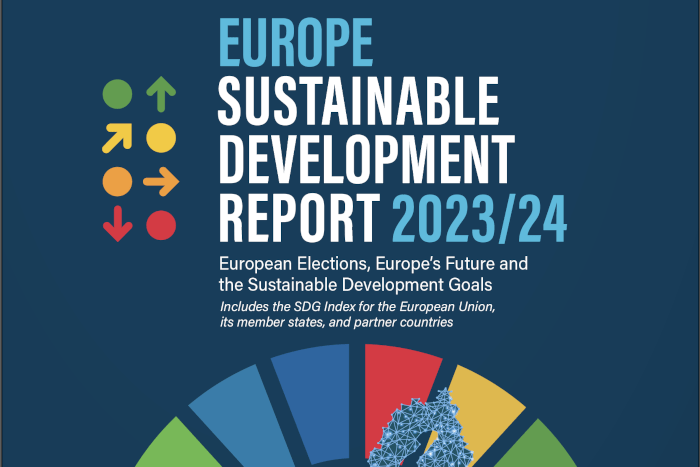
The Europe Sustainable Development Report 2023/24, produced by the UN Sustainable Development Solutions Network (SDSN) in collaboration with SDSN Europe and the European Economic and Social Committee (EESC), reveals that decisive actions must be taken in the European Union (EU) to avoid environmental and social ‘tipping points’ and to maintain the promise of achieving the SDGs of the 2030 Agenda and the objectives of the Paris Climate Agreement.

The fifth edition of the ESDR, which includes the SDG Index and Dashboards, tracks progress on the SDGs of the EU, its Member States, and partner countries in Europe. The report highlights that at the current rate, a third of the SDG targets will not be achieved by the EU by 2030, with significant differences across European countries; these range from a quarter in Northern and Western Europe to around half in Southern Europe and Central and Eastern Europe on average.
In particular, the report underlines stagnation and reversal in progress in many European countries on social targets with growing issues around access to and quality of services for all, as well as poverty and material deprivation driven at least partly by multiple crises since 2020. Globally, the international financial architecture is failing to channel global savings to SDG investments at the needed pace and scale which leads to a reversal in SDG progress in many parts of the world, especially in the poorest and most vulnerable countries.
This year’s report provides essential contributions for the EU to strengthen its SDG leadership at home and internationally ahead of the June 2024 European elections and the Summit of the Future convened by the UN Secretary-General in September 2024.
Guillaume Lafortune, Vice President of the SDSN and a lead author of the report, emphasised: “Political parties campaigning for the European elections and the future leaders of the European Union have historic responsibilities. The Sustainable Development Goals adopted by all UN Member States in 2015 are not being achieved in Europe and globally, yet they remain the future Europe and the world want. Decisive actions must be taken during this decade.
“This is not the time to backtrack or water down what has been achieved and agreed on to support the implementation of the SDGs and Paris Climate Agreement. Long-term investments and regional cooperation are required to boost skills and innovation and provide equal opportunities for all. In a multipolar and fragmented world, coalitions of European thought leaders must work together to lay the foundations for a new European Deal for the Future and play a leadership role internationally to prepare for the next decades of global sustainable development.”
Adolf Kloke-Lesch, Co-Chair of SDSN Europe and another lead author of the report added: “The EU should turn its global role and broad networks into powerful tools of global transformation. By aligning its external policies to the global common good expressed in the 2030 Agenda with the SDGs, the EU can only bolster its long-term strategic autonomy.
“The EU should work closely with the G21 Presidencies of Brazil (2024) and South Africa (2025) and the G7 Presidencies of Italy (2024) and Canada (2025) to get the SDG agenda back on track. Within both groups, the EU, France, Germany, and Italy should form a dedicated ‘Team Europe for the SDGs’ to strive for an open and cooperative international order to advance global sustainable development. In today’s world, international cooperation must progressively become mutually transformative, giving partners a voice and means also in the European Financial Architecture as well as regarding policy measures and developments in the EU that highly affect them.”
 Sustainable Development Solutions Network UK