In February 2026, SDSN UK members from across the country gathered online for an energising ‘Meet the Chair’ session — the first opportunity to welcome Professor Gail Taylor in her new role as Chair of SDSN UK, and to explore the network’s growing partnership with UN Global Compact UK through the ‘SDG Reactor’.
“In a nutshell, the network aims to bring the rigor of academic research into business action.” Sam Balch, Director of Grand Challenges, UCL
The SDG Reactor, hosted by UCL in partnership with SDSN UK and the UN Global Compact UK, has been recognised by QS Insights for its innovative role in bridging academia and business to accelerate progress on the UN Sustainable Development Goals (SDGs).
What Makes SDG Reactor Unique
Launched in October 2025, the SDG Reactor connects leading universities in the UK with nearly 1,000 businesses through UNGC UK, enabling knowledge exchange and joint action on sustainability. The SDG Reactor will create knowledge exchange spaces such as roundtables and webinars, facilitating shared learning across sectors and highlighting the power of collective problem-solving to address the SDGs.
In October, I had the privilege of representing SDSN UK at the SDSN Global and Network Managers Workshop in Kuala Lumpur, Malaysia. The week brought together sustainability leaders and network managers from across the world. Each committed to a shared mission: accelerating the implementation of the Sustainable Development Goals (SDGs) through collaboration, innovation, and knowledge exchange.
A Global Snapshot of Creativity, Solidarity, and Urgency Across several days of discussions, case studies, and interactive sessions, I was struck by the diversity of approaches being taken to drive sustainable development. From climate-smart cities to innovative financing models, the creativity of solutions emerging worldwide was extraordinary.
One moment that particularly stayed with me was hearing about the immediate impacts of climate change unfolding in the Philippines. During the week of our workshop, the country was struck by three typhoons, forcing campuses to close and students to pivot back to online learning. It was a humbling and sobering reminder that even as we make progress, our communities remain vulnerable to escalating environmental extremes.
Bridging Knowledge and Action: Lessons from Global Networks Examples from other SDSN networks showcased the power of cross-sector alliances. SDSN Italy’s work with local governments demonstrated how universities can be trusted advisors, embedding SDGs directly into city-level planning. This inspired reflections on how the UK might consolidate currently fragmented local initiatives ensuring that academic, civic, and governmental actors collaborate early and effectively.
Finance and data also emerged as critical enablers. Innovative models, such as those presented by SDSN Benin, illustrated the value of linking academia with financial institutions to mobilise green finance and strengthen data-driven decision making.
SDSN UK’s Contributions to the Global Dialogue During the workshops, SDSN UK contributed to three key discussions:
How the interconnected nature of the SDGs can help elevate goals that are currently lagging behind
The growing role of citizen science in SDG-related data collection
The need to remain bold in our efforts, even amid geopolitical uncertainties
Lessons from Regional Leaders: Creating platforms for research, innovation and development The workshop also featured external sessions led by the Asia School of Business (ASB) and the Jeffrey Sachs Centre on Sustainable Development (JSC) at Sunway University. ASB offered insights into how companies can embed sustainability into core strategies, while JSC shared ongoing research on biodiversity, climate resilience, and SDG tracking across Malaysian states.
The SDSN Secretariat also introduced SustainChain, a platform leveraging AI and machine learning to accelerate sustainable progress through a community of over 2,000 organisational members. Over the coming months, SDSN UK will explore how SustainChain can support the SDG Reactor Partnership between SDSN UK and UNGC UK.
Looking Beyond 2030: What Comes Next for the Global Goals? Another theme that resonated throughout the workshop was the question of what the global agenda should look like after 2030. As the SDG deadline approaches, participants reflected on emerging priorities such as digital transformation, biodiversity restoration, social resilience, and the circular economy. There were even discussions around potential new thematic goals, including responsible AI, an area rapidly shaping our economies and societies, one that we couldn’t foresee in 2015.
For SDSN UK, this presents a clear role: convening researchers, policymakers, civil society, and young people to contribute evidence-based insights and help shape the UK’s voice in the post-2030 agenda. Our partnership with UNGC UK, under the SDG Reactor will bring together events with a focus on practical strategies to contribute to the dialogue.
Building Partnerships for the Future The workshop concluded with a session on strategic stakeholder engagement, held in conjunction with the World Business Council for Sustainable Development’s 2025 Leadership Program. The interactive session, facilitated by Assoc. Prof. Dr. Priya Sharma of Sunway University, reinforced the importance of cross-sector partnerships in driving systemic change. The SDSN Secretariat also presented the Universities for Goal 13 initiative—hosted by UCL—as an example of successful collaboration between academia and the private sector.
Looking Ahead: Global Learning, Local Action As I reflect on the week, I’m reminded that while the SDGs offer a global framework, real transformation takes place locally. Our local efforts must be bold, ambitious, and unwavering as we work to shape a just and sustainable future for generations to come. In the spirit of the Sustainable Development Goals, we are called—both as communities and as global citizens—to rise above the narratives that limit our imagination. We must envision and build a world where prosperity is guided not by inherited systems, but by intentional, conscious choices that honour people, planet, and place.
SDSN UK Hub is establishing the UK SDG Reactor network, with funding from UKRI’s Higher Education Innovation Fund.
The Reactor will connect two influential communities: the SDSN UK and UN Global Compact Network UK to foster collaboration, innovation, and impact across sectors. It will be led by Professor Gail Taylor, Chair of SDSN UK and Dean of the Faculty of Life Sciences at UCL.
The UK SDG Reactor will support targeted, high impact activities, designed to translate research into practice, build capacity, and foster innovation. This includes providing data and insight on sustainability leadership and best practice, creating opportunities for professional learning, and cross-sectoral knowledge sharing.
The project will be supported by an Innovation Network grant with funding from Research England, Higher Education Innovation Fund (HEIF), managed by UCL Innovation & Enterprise.
Speaking on the announcement, Professor Taylor said:
“The SDG Reactor represents a powerful opportunity to harness the collective research and knowledge strengths of the Sustainable Development Solutions Network UK, which we’re proud to host at UCL. With over 20 member institutions – including many of the UK’s leading universities – SDSN UK is driving practical, evidence-based solutions to the Sustainable Development Goals. By partnering with UN Global Compact UK, we’re combining academic insight with business leadership to accelerate progress on the most pressing challenges facing society. Together, we aim to deliver impact that is greater than the sum of our parts.”
The Higher Education Innovation Fund (HEIF) supports dynamic knowledge exchange between universities and the wider world, fostering collaborations that deliver tangible benefits to society and the economy. Through its £260 million programme, HEIF enables higher education institutions to engage in a broad spectrum of knowledge-based activities. This can range from research partnerships to professional development initiatives. These projects must respond to real world issues and drive innovation across sectors. The fund is designed to sustain and grow these interactions, ensuring that academic expertise translates into meaningful impact for communities, businesses, and public policy.
SDSN UK is the national hub of the UN-mandated SDSN Global. Established in 2022, SDSN UK mobilises universities and knowledge institutions across the UK to advance the UN 2030 Agenda for Sustainable Development. With over 20 member organisations, SDSN UK drives collaborative research, education, and policy engagement to develop practical solutions to complex sustainability challenges. Its activities include convening national conferences, producing independent assessments of UK SDG progress, and partnering with government, business, and civil society to strengthen the UK’s SDG ecosystem.
UN Global Compact UK is part of the world’s largest corporate sustainability initiative, connecting UK-based organisations to a global movement committed to advancing responsible business practices. Through practical action and strategic partnerships, the network helps businesses align with universal sustainability principles and contribute meaningfully to the UN Sustainable Development Goals. With nearly 1,000 member organisations, it provides access to cutting-edge resources, peer learning, and expert guidance across areas such as climate action, human rights, governance, and sustainable finance.
By Professor Gail Taylor, Chair of SDSN UK and Dean of Life Sciences at UCL 29th September 2025
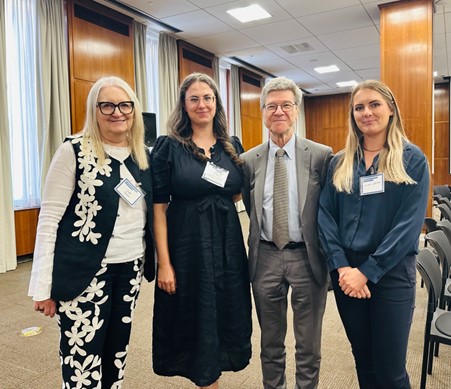
Last week, I had the privilege of representing SDSN UK at the global Chairs meeting and Leadership Council of the Sustainable Development Solutions Network (SDSN) in New York. SDSN is a worldwide alliance of universities committed to advancing the UN Sustainable Development Goals (SDGs) through research, education, and policy innovation.
With over 20 UK universities now part of SDSN UK network, our collective voice is growing stronger. Hosted by SDSN President Professor Jeffrey Sachs, the meeting brought together national Chairs to share progress and shape the future of sustainable development in higher education.
Professor Sachs spoke with urgency and passion about the SDGs, underscoring the need for interdisciplinary collaboration—a hallmark of the SDSN network. We explored global initiatives ranging from reimagining Rwanda’s cold chain to reduce food waste, to the European Climate Hub’s work on land use and agricultural sustainability.
A major highlight was SDSN’s new partnership with Sustainchain , an AI-powered platform designed to accelerate global sustainability. This collaboration will connect over 2,000 SDSN member institutions, enabling deeper cooperation and unlocking synergies across the SDG ecosystem.
SDSN continues to be a powerful platform for UCL and the wider UK network to engage globally—driving forward education, research, and real-world solutions for a sustainable future.
We’re delighted to announce that Prof. Gail Taylor (Dean of Life Sciences, UCL) is the new Chair of Sustainable Development Solutions Network UK.
Prof. Taylor is uniquely positioned to provide a vision for SDSN UK as it goes from strength to strength. She recently joined UCL as Dean of the Faculty of Life Sciences, having been Chair of Plant Sciences at University of California, Davis and before that Reader and Director of Research for the School of Biological Sciences at the University of Southampton. Prof. Taylor’s research covers Plant, Environment and Sustainability Science, focused on the societal challenges of Sustainable Food and Energy Production and Adaptation to the Changing Environment, particularly through research that crosses disciplinary boundaries. She is currently a Coordinating Lead Author of the UN Environment Programme’s GEO-7 state of the planet report that will be published in 2026.
Prof. Taylor says “I am delighted to be the new chair of SDSN UK, hosted by UCL. This is a great opportunity to work together with other leading knowledge centres across the UK to develop and accelerate practical solutions to the UN Sustainable Development Goals. It is imperative that we identify transformative actions to address a planet in crisis and work together to implement these at local, national, and global scales by joining up research and innovation, education, and policy.”
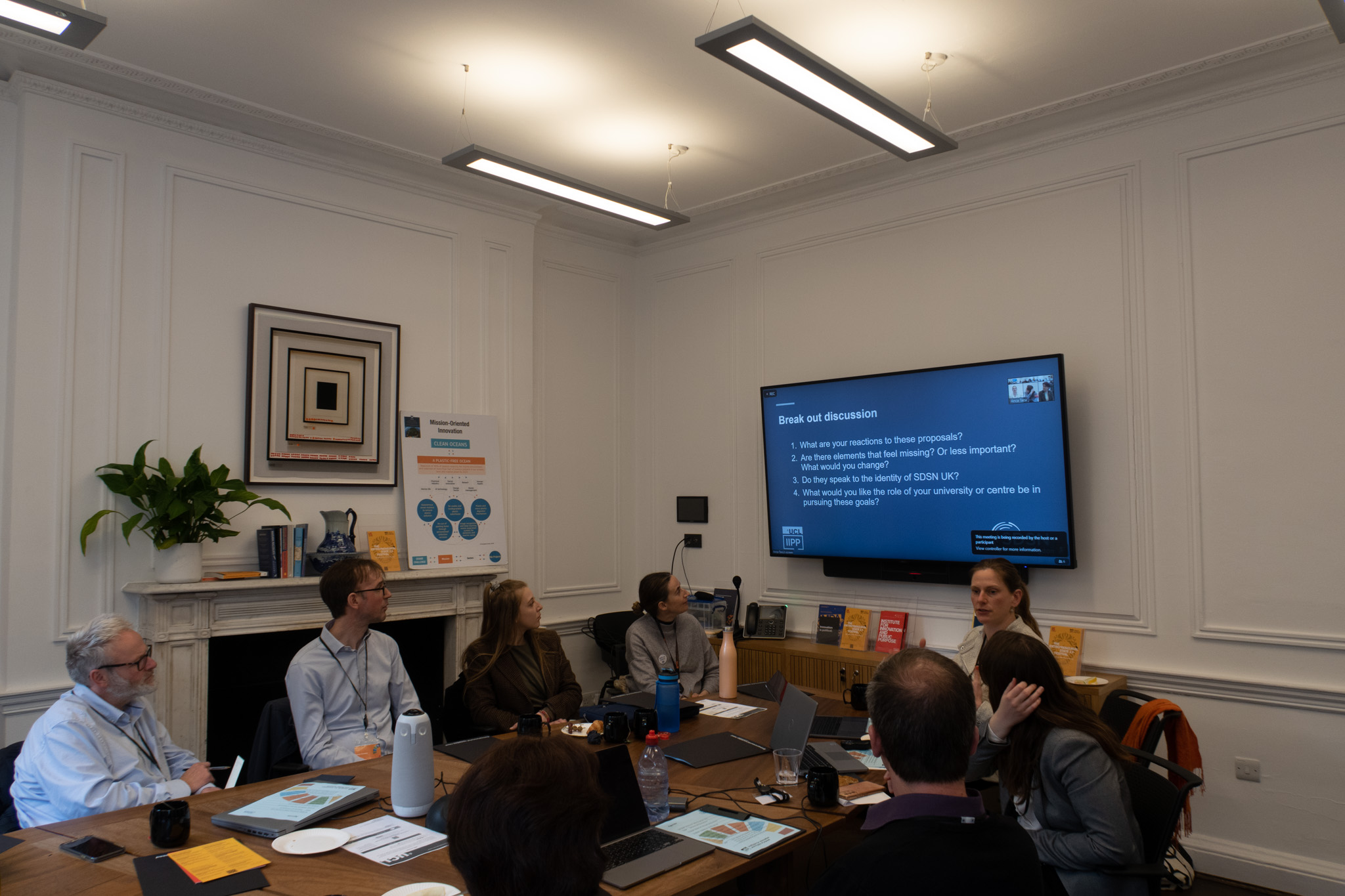
More than 40 Sustainable Development Solutions Network (SDSN) UK members and stakeholders met to build momentum for the contribution of UK higher education institutions to the UN Sustainable Development Goals (SDGs).
SDSN UK, hosted at UCL Institute for Innovation and Public Purpose (IIPP), has convened its membership and collaborators in person for the first time since its launch.
SDSN UK was set up to bring together UK knowledge institutions around practical solutions that contribute to the implementation of the 17 UN Sustainable Development Goals (SDGs). In the first part of the event, on 26 April 2023, SDSN UK members gathered at IIPP to review the first year of activities and achievements of the network, which has now grown to more than 20 UK universities and research centres, and discussed strategic orientations for 2023-2025.
As the host institution for the UN Sustainable Development Solutions Network (SDSN), IIPP will convene UK universities to advance practical solutions to achieve the 2030 agenda for sustainable development. Read more here





 Sustainable Development Solutions Network UK